
Space Opera Is Having a Renaissance (And You’re Going to Love It)
Space opera is science fiction at its most ambitious: galaxy-spanning adventures where human drama unfolds against backdrops of interstellar empires, alien civilizations, and technology that bends the rules of physics. If you’re searching for space opera right now, you’re catching the genre at a remarkable cultural moment. After years of dystopian fatigue, readers are returning to stories that balance spectacle with genuine emotion, and 2026 has already delivered recognition to prove it. J. Kenton Pierce’s A Kiss for Damocles claimed the Prometheus Award for Best Novel, while Dave Freer’s Storm-Dragon won the Special Prometheus Award for Young Adult Fiction. Jessica Thorne earned a nomination for the European Science Fiction Society’s Hall of Fame awards, signaling that the space opera renaissance has serious momentum.
What makes space opera particularly appealing isn’t just the scale. These stories promise escape without abandoning substance. The best examples tackle questions about identity, power, and belonging while delivering the starship battles and alien encounters that make science fiction irresistible. You’ll find authors exploring what happens when entire civilizations collide, when loyalties stretch across light-years, when characters must choose between personal connections and cosmic stakes.
Whether you’re new to the genre or returning after years away, the challenge is finding your entry point. Space opera ranges from military-focused sagas to character-driven epics, from hard science foundations to pure adventure. This guide will walk you through what defines the genre today, why it’s experiencing this resurgence, and how to discover the books that match exactly what you’re craving. The community of space opera readers is welcoming, passionate, and eager to share recommendations that go beyond the obvious classics.
What Makes Space Opera So Irresistible
Space opera works because it gives you everything at once: the thrill of discovery, the weight of impossible choices, and characters whose decisions ripple across galaxies. Unlike more constrained science fiction, space opera embraces bigness. It doesn’t apologize for sweeping storylines that span star systems or conflicts that determine the fate of civilizations. That epic scope is precisely what makes it irresistible.
The canvas matters. When your setting stretches across multiple worlds, each with distinct cultures, politics, and ecosystems, you’re not just reading about space travel. You’re exploring what it means for humanity (or alien species) to exist on a cosmic scale. These interstellar settings create room for world-building that feels genuinely expansive, where a single decision in one corner of the galaxy can trigger consequences light-years away.
Then there are the characters. Space opera doesn’t do small personalities. You get pilots who can navigate asteroid fields by instinct, diplomats negotiating peace treaties between species that communicate through bioluminescence, rebels leading uprisings against empires that have ruled for millennia. These larger-than-life figures aren’t superheroes, though. The best space opera grounds its heroes in very human struggles: loyalty versus duty, survival versus principle, love in the face of war.
Adventure and conflict drive the momentum. Space battles, political intrigue, first contact scenarios, espionage across planetary networks, space opera combines action with genuine stakes. But it’s the emotional weight that keeps you turning pages. When a character risks everything to save a colony or chooses between their crew and their mission, you feel it because the story has earned those moments through careful build-up.
What really sets space opera apart is how it blends hard science fiction elements with operatic drama. You might get detailed explanations of faster-than-light travel alongside passionate romances or family betrayals worthy of Shakespeare. That combination, technical world-building meeting grand emotional storytelling, creates the immersive experiences readers crave. It’s science fiction that doesn’t make you choose between intellectual satisfaction and emotional investment.
Space opera invites you to dream bigger, to consider what humanity could become when the frontier isn’t a new continent but entire galaxies waiting to be discovered.
Space Opera’s Moment in 2026
Space opera is claiming its place in the spotlight right now, with prestigious awards and literary festivals spotlighting the genre’s best works and most innovative voices. The recognition spans continents and communities, proving that readers and critics alike are embracing these grand galactic tales.
The 2026 Prometheus Awards delivered a powerful statement about space opera’s vitality. Dave Freer’s Storm-Dragon won Young Adult Fiction honors, while J. Kenton Pierce took home Best Novel for A Kiss for Damocles. Both works exemplify the genre’s ability to blend thrilling adventure with meaningful themes about freedom and human nature, demonstrating why space opera resonates so strongly with contemporary audiences.
Genre festivals are responding to this momentum by creating dedicated spaces for space opera conversations. When Words Collide in Calgary features panels exploring speculative fiction’s craft and appeal, including discussions on cinematic storytelling techniques and the balance between scientific rigor and narrative accessibility. These sessions draw writers and readers together to examine what makes the genre tick and where it’s headed next.
The literary community’s embrace extends beyond awards ceremonies. Writers festivals are booking more science fiction authors, reading groups are dedicating months to space opera selections, and online communities are buzzing with recommendations and debates about which new releases deserve attention. This isn’t a quiet niche gathering anymore. It’s a genre-wide celebration.
What makes this moment particularly exciting is the diversity of voices earning recognition. The genre is attracting fresh perspectives while honoring established masters, creating a rich ecosystem where newcomers and veterans alike push boundaries. Awards like the Ursula K. Le Guin Prize 2026 emphasize speculative fiction that imagines alternative worlds and social structures, encouraging space opera authors to think bigger and bolder.
The festivals, awards, and community engagement we’re seeing this year signal something larger than a temporary uptick in popularity. Space opera has reclaimed its cultural relevance, offering readers the epic scope and imaginative freedom they’re craving right now.
Why Readers Are Returning to Epic Space Adventures
Something about the current moment is calling readers back to the vast reaches of space opera. It’s not nostalgia alone, though the genre’s golden age still casts a long shadow. Rather, space opera in 2026 offers something we’re desperately craving: escapism with purpose.
When the world feels small and overwhelming, space opera takes us somewhere genuinely different. These aren’t gentle escapes, space opera offers readers the chance to grapple with enormous questions about civilization, survival, and what it means to be human, all while following characters who face challenges on a cosmic scale. There’s comfort in watching protagonists tackle universe-spanning conflicts when our own problems feel insurmountable. The genre’s tradition of high-stakes fiction translates beautifully to interstellar settings where the consequences truly are astronomical.
Against a backdrop of uncertainty, space opera also dares to be optimistic. Not naively so, the best space operas don’t shy from darkness or moral complexity, but ultimately hopeful. They imagine futures where humanity (or its alien neighbors) survives, explores, and builds something lasting among the stars. That forward-looking spirit resonates deeply right now.
The genre is also expanding in ways that make it more accessible and relevant. Diverse voices are bringing fresh perspectives to space opera’s grand narratives, exploring how different cultures and identities might shape interstellar civilizations. These aren’t just white, Western futures anymore, and that broadening feels overdue and genuinely exciting.
There’s another draw too: space opera balances hard science with emotional storytelling in a way few genres manage. You can get lost in the mechanics of faster-than-light travel one moment and be moved by a character’s sacrifice the next. The best space opera doesn’t choose between big ideas and human stakes, it demands both.
Recent recognition for works like Dave Freer’s Storm-Dragon and J. Kenton Pierce’s A Kiss for Damocles shows the genre’s vitality, while Jessica Thorne’s nomination for the European Science Fiction Society’s Hall of Fame highlights how space opera continues to evolve. Readers aren’t just returning to space opera, they’re discovering it can still surprise them.
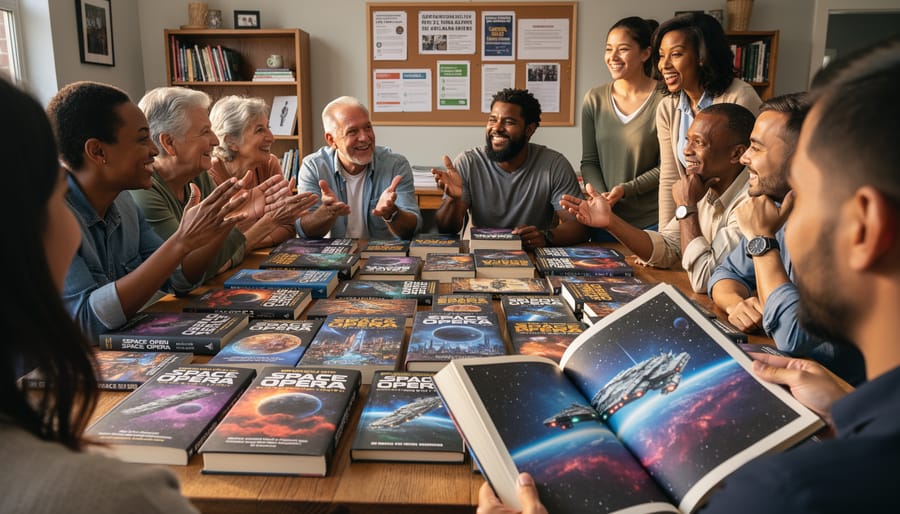
Must-Read Space Operas for Every Type of Reader
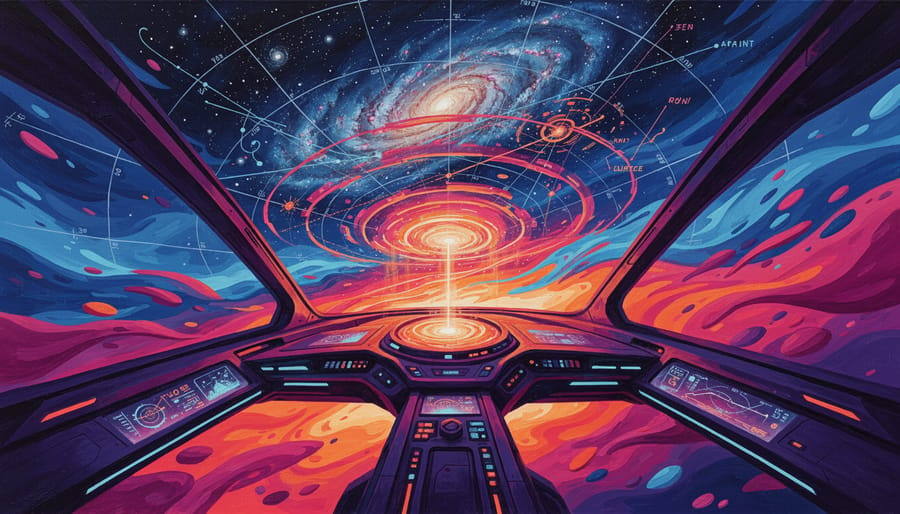
The beauty of space opera lies in its versatility. Whether you’re craving explosive battles, deep emotional arcs, rigorous science, or sweeping romance, there’s a corner of the genre waiting for you.
- Action Lovers
- Military space opera delivers tactical combat, fleet maneuvers, and strategic warfare across star systems. Expect adrenaline-fueled sequences balanced with crew dynamics and high-stakes decision-making.
- Emotional Readers
- Character-driven epics focus on personal journeys, moral dilemmas, and relationships against cosmic backdrops. These stories prioritize internal conflict and transformation alongside external adventure.
- Detail-Oriented Fans
- Hard science space opera grounds its narratives in plausible physics, biology, and engineering. You’ll find meticulously researched technology and consequences that follow scientific principles.
- Relationship-Focused Readers
- Space opera romance weaves love stories into interstellar settings, offering everything from slow-burn courtships to passionate encounters amid galactic conflicts. The relationships drive the plot as much as any external threat.
- Younger or Newer Genre Readers
- YA space opera introduces genre conventions through accessible prose and relatable protagonists discovering their place in the universe. Perfect for weekend reading that still delivers epic scope.
Community readers consistently highlight how these distinctions help them navigate the genre’s breadth. Some prefer mixing categories, starting with character-driven stories before exploring harder science offerings, while others commit to a single lane. There’s no wrong approach.
What readers appreciate most is how space opera accommodates shifting moods. You might reach for military-focused adventures when you want pulse-pounding tension, then switch to romance-centered tales when you’re craving connection. The best sci-fi sagas often blend multiple elements, which is why readers who think they prefer one style frequently discover unexpected favorites in adjacent categories.
Dave Freer’s 2026 Prometheus Award-winning Storm-Dragon demonstrates how YA space opera can appeal across age groups, offering both accessible entry points and sophisticated world-building. Similarly, J. Kenton Pierce’s A Kiss for Damocles, also a 2026 Prometheus winner, shows how adult-oriented space opera can balance philosophical depth with compelling narrative drive.
The key is starting somewhere that matches your current reading appetite, then letting curiosity guide you outward. Many readers find that space opera’s expansive nature means there’s always another subgenre or author to explore.
How to Find Your Next Space Opera Adventure
Finding your next great space opera is easier than you think, especially with a community of passionate readers ready to point you toward hidden gems. Start with trusted sources like online reading communities dedicated to science fiction and fantasy. Platforms like Reddit’s r/PrintSF, Goodreads groups, and genre-specific Discord servers buzz with real-time recommendations from readers who’ve been where you are. They’ll steer you toward books that match your specific tastes, whether you’re craving hard science, character drama, or swashbuckling adventure.
Award nominations offer another reliable compass. Keep an eye on the Prometheus Awards (which recognized space opera works in 2026), the Hugo Awards, and regional honors like the European Science Fiction Society’s Hall of Fame. These aren’t just industry accolades, they’re signals that a book has resonated deeply with genre fans.
Literary festivals create face-to-face discovery opportunities you won’t find online. The St. Lawrence Writers Festival in Brockville, Ontario (September 10-13, 2026) brings together authors and readers for intimate conversations about the books shaping speculative fiction right now. Similar events let you hear directly from writers, ask questions, and get personalized recommendations from fellow attendees who share your reading DNA.
Don’t underestimate curated lists from independent bookstores and library staff picks. These folks read voraciously and love connecting the right book with the right reader. Ask your local bookseller or librarian for space opera suggestions, they often know emerging authors before the wider world catches on.
Finally, follow your favorite authors on social media. Writers generously share what they’re reading, and their recommendations carry weight. If you loved one space opera, chances are its author can point you toward three more you’ll adore. The space opera community thrives on this spirit of generous sharing, turning every great read into a gateway to the next adventure.
Space opera isn’t just having a moment, it’s proving that grand-scale storytelling, filled with wonder and humanity, never really goes out of style. The genre’s current resurgence shows us that readers are hungry for stories that transport them beyond the everyday, that ask big questions while delivering thrilling adventures across the stars.
Whether you’re rediscovering beloved classics or diving into space opera for the first time, there’s never been a better moment to explore what the genre has to offer. The voices shaping space opera in 2026 are more diverse than ever, bringing fresh perspectives to familiar themes of exploration, conflict, and connection. From award-winning novels to debut authors making waves, the reading community is buzzing with recommendations and discoveries.
We’d love to hear what draws you to space opera. Are you captivated by military strategy and space battles, or do you prefer character-driven epics that explore what it means to be human among the stars? Maybe you’re searching for your next great read and want to know where to start. Our community thrives on shared enthusiasm, so don’t hesitate to join the conversation. Check out our sci-fi releases and top sci-fi picks for more inspiration, and share your favorites with fellow readers who appreciate the limitless possibilities of the genre.
The stars are calling. What adventure will you choose first?
About Author
